
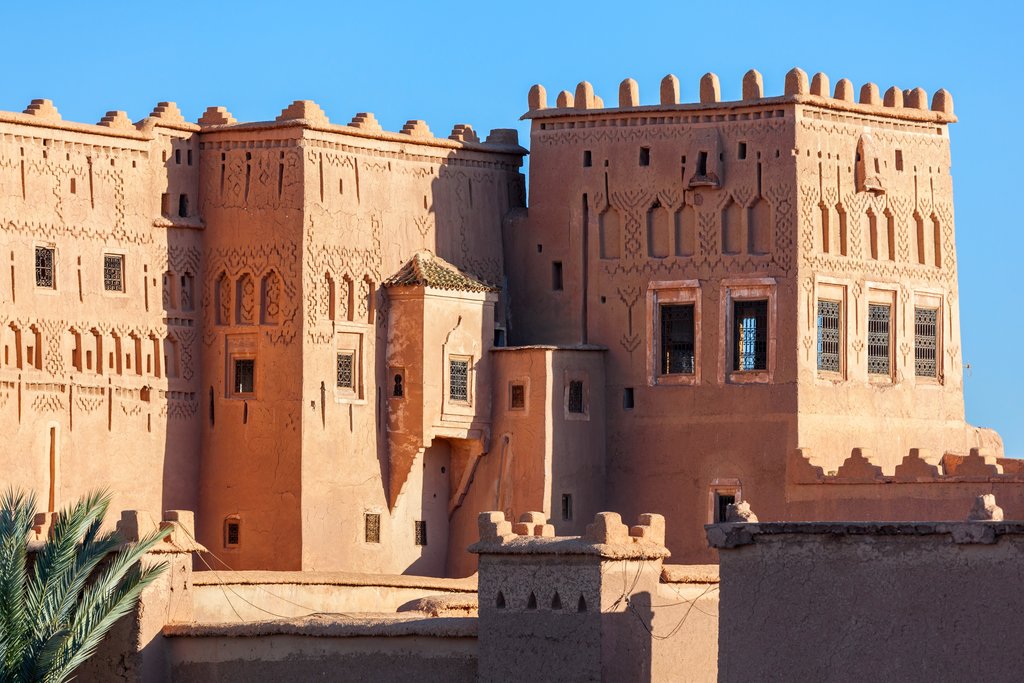
6-Day Custom Jewish Heritage Tour of Morocco
Six days through the heart of Moroccan Jewish heritage.
This private six-day tour traces the living and historic legacy of Moroccan Jewry from the magnificent mellah of Marrakech through the dramatic High Atlas Mountains, into the ancient kasbah country of Ouarzazate, east to the sacred tomb of Rabbi Abu Hzeira in Arfoud, and finally to the golden dunes of Merzouga before returning via the Draa Valley to Marrakech.
You will walk through one of the oldest Jewish quarters in the Arab world, stand inside a centuries-old synagogue carved from adobe in the Saharan foothills, and spend a night under desert stars at a private camp near the tomb of one of the most revered Jewish saints in the Moroccan tradition.
This tour is fully private — designed and escorted exclusively for your group. Your specialist guide brings deep knowledge of Moroccan Jewish history, Sephardic tradition, and the landscape through which the communities lived. Every detail, from accommodation to site access, is arranged in advance.
Covered Destinations
Synagogues, tombs & Jewish heritage sites visited.
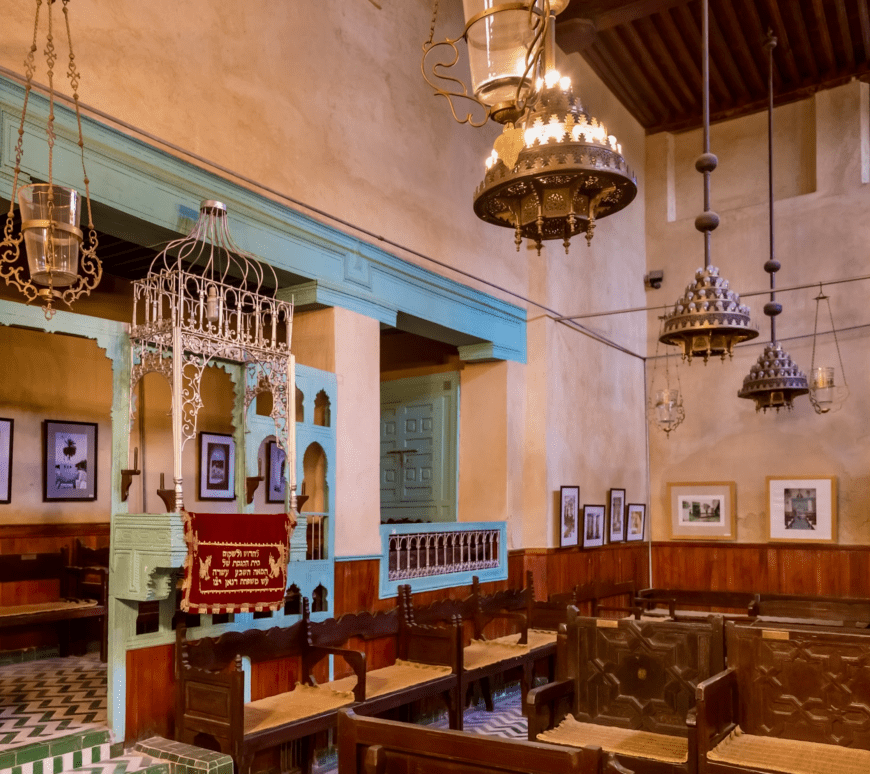
Lazama Synagogue
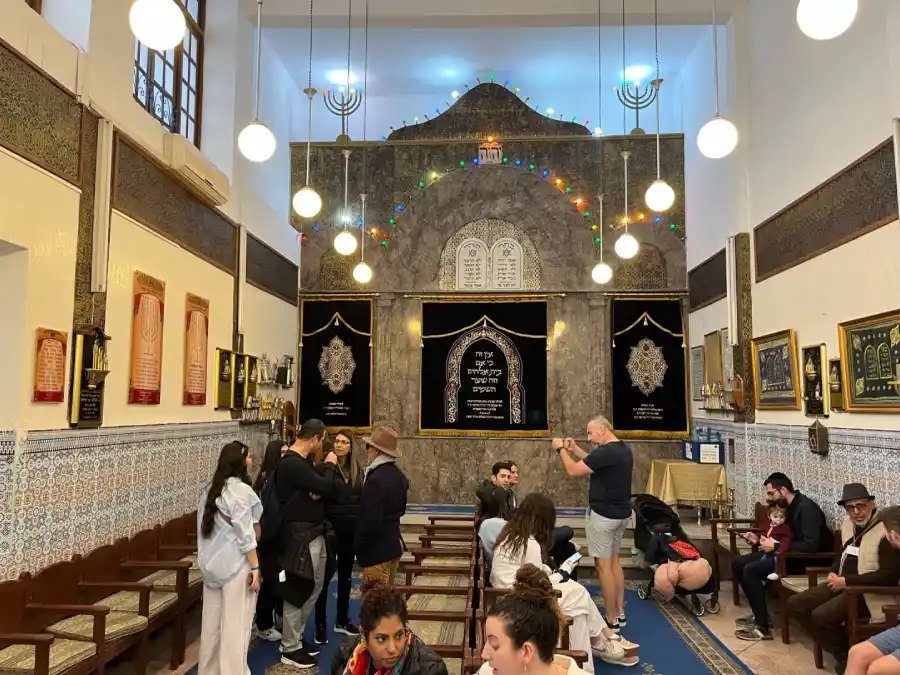
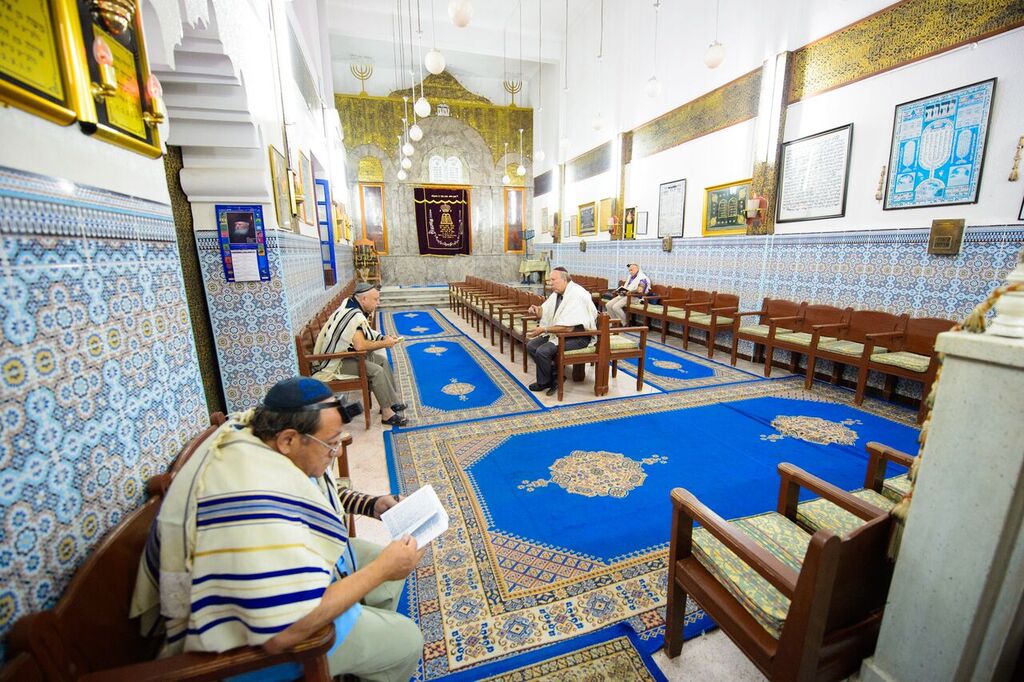
One of the oldest active synagogues in Morocco, tucked inside the Marrakech mellah. Dating to the 16th century, it is still used today and houses a remarkable collection of Torah scrolls and Jewish artifacts.
Marrakech Mellah
The Jewish quarter of Marrakech, established in 1558, is one of the best-preserved mellahs in Morocco. Its distinctive architecture, covered souks, and cemetery tell the story of a once-thriving community of over 18,000 Jews.
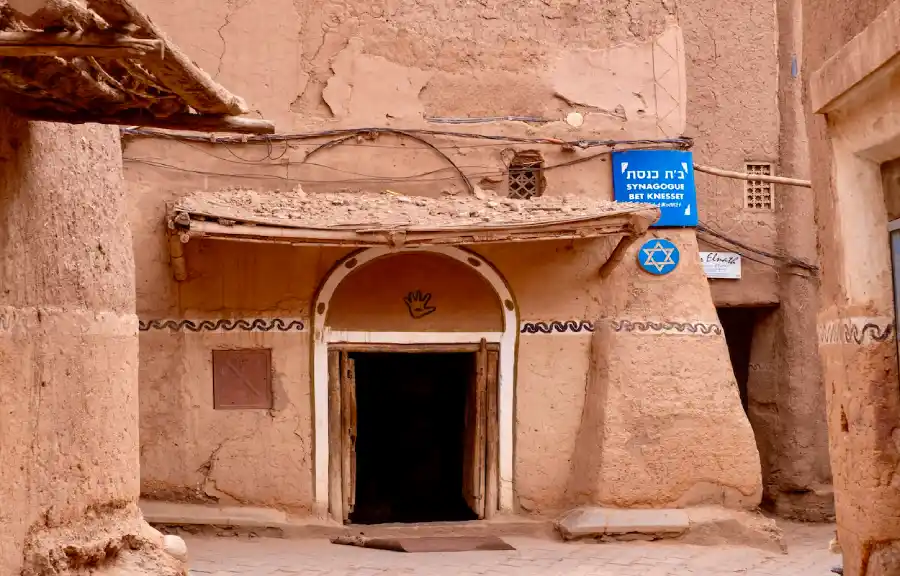
The Old Synagogue of Ouarzazate
An extraordinary adobe synagogue in the kasbah country of the Saharan foothills. A rare example of Jewish sacred architecture built in traditional southern Moroccan style. View on TripAdvisor ↗
Tomb of Rabbi Abu Hzeira
The sacred hilulot shrine of Rabbi Yaakov Abu Hzeira, known as the Abuhatzeira dynasty. One of the most venerated Jewish pilgrimage sites in Morocco, drawing thousands from Israel and around the world each year.
Jewish Heritage Sites of the Draa
The Draa Valley was home to significant Jewish communities for centuries. En route back to Marrakech, we visit the remains of Jewish villages, mellah ruins, and cemeteries that trace this ancient presence.
Jewish Mountain Communities
The High Atlas contained dozens of Jewish villages known as mellah oufella — mountain mellahs. We pass through areas where Jewish families lived as traders and craftsmen among Berber communities for generations.
What makes this journey unforgettable.
Full Day in Marrakech's Jewish Quarter
A deep guided immersion into the mellah, Lazama Synagogue, the Jewish cemetery, and the cultural history of Marrakech's Jewish community — one of the most vibrant in Morocco's history.
High Atlas Mountain Drive and Aït Ben Haddou
Cross the Tizi n'Tichka pass through the High Atlas, visiting the UNESCO World Heritage kasbah of Aït Ben Haddou — a landscape that has housed Jewish traders for over a thousand years.
The Adobe Synagogue of Ouarzazate
An exceptional and rarely visited site — a synagogue built entirely in the traditional pisé and adobe architecture of southern Morocco. A profound reminder of centuries of Jewish-Berber coexistence.
Pilgrimage to Rabbi Abu Hzeira
Visit the shrine of one of Morocco's most beloved Jewish saints. The Abuhatzeira dynasty is revered across the Sephardic world, and this sacred site remains one of the most significant stops on any Moroccan Jewish journey.
Overnight in the Sahara Desert
Spend a night at the edge of the Erg Chebbi dunes in a private desert camp. The silence, the stars, the landscape — it adds a dimension to this journey that is genuinely difficult to put into words.
The Draa Valley — Ancient Jewish Homeland
One of the oldest continuously inhabited Jewish landscapes in Morocco. The return route passes through villages where Jewish families lived for generations, with your guide bringing the history to life throughout.
Detailed itinerary.
All timings are approximate and may be adjusted to suit your group's preferences. Your guide is flexible and responsive throughout.
Day 1
Arrival in Marrakech
Arrive at Marrakech Menara Airport or by train. A Shalom Morocco driver will be waiting for you and will bring you to your riad in or near the medina. The rest of the afternoon is yours — walk the neighbourhood, get your bearings, rest if you need to.
In the evening, sit down with your guide over tea for a first conversation about the journey ahead. They will give you an introduction to Moroccan Jewish history — a story stretching back more than 2,500 years — which will provide the context for everything you see over the following days. If you feel like it, they can take you for a short walk along the edge of the mellah as the city settles into the evening.
Day 2
Full Day Guided Tour — Marrakech Jewish Heritage
No driving today — all on foot within the medina
Today is entirely on foot inside the old city. The mellah of Marrakech was established in 1558, when the Saadian sultan relocated the Jewish community from the medina centre to this quarter alongside the royal palace — a position that brought both proximity to power and a degree of royal protection. Your guide walks you through the neighbourhood, pointing out the distinctive architecture: the tall, inward-facing houses with their small upper-floor windows designed to look over the street without being overlooked, the covered market passages, and the remnants of a community that numbered over 18,000 people at its peak in the 1940s.
The centrepiece of the morning is the Lazama Synagogue — one of the oldest active synagogues in Morocco. It is still used today, and your guide will introduce you to whoever is there, explain the significance of the Torah scrolls and the ark, and tell you about the families who maintained this space through decades of departure and return.
From there, you walk to the Jewish Cemetery of Marrakech, which is one of the most important in North Africa. The Hebrew inscriptions tell individual family stories spanning centuries. Your guide is very good at making these readable — connecting names and dates to the wider sweep of Moroccan Jewish history in a way that stays with you.
The afternoon is more flexible — a visit to the Maison de la Photographie or a walk through the souks with your guide explaining the trade relationships that Jewish and Muslim families maintained for generations. Lunch at a traditional restaurant where your guide can talk you through the Jewish origins of several dishes still common on Moroccan tables today.
Day 3
Marrakech — High Atlas — Aït Ben Haddou — Ouarzazate
Approx. 200 km / 4–5 hours driving including stops
Leave Marrakech in the morning and head south on the N9 towards the High Atlas. The road climbs steadily through increasingly dramatic scenery to the Tizi n'Tichka pass at 2,260 metres — the highest paved mountain pass in North Africa. As you drive, your guide will describe the Jewish communities that lived in these mountain valleys for centuries, working as traders and craftsmen among Berber farming families. It is one of the more unusual chapters in Moroccan Jewish history, and the landscape makes it vivid in a way that a book cannot.
After the pass, drop down towards the plains and stop at Aït Ben Haddou, the extraordinary UNESCO-listed kasbah village on the edge of the pre-Saharan desert. It has been inhabited since at least the 11th century and sat on the trans-Saharan caravan routes that Jewish merchants were deeply involved in sustaining. A short walk through the kasbah with your guide connects the place to its history in a very concrete way.
Continue a short distance east to Ouarzazate for the main event of the day: a visit to The Old Synagogue of Ouarzazate. This is not the kind of synagogue most people expect. It is built entirely in the traditional pisé and adobe architecture of southern Morocco — the same material as the kasbahs all around it. A synagogue that, from the outside, looks exactly like its surroundings. Inside, it is recognisably a place of Jewish worship, and the combination — the familiar made strange, the foreign made local — is genuinely affecting. Your guide provides full historical context about the Jewish community of Ouarzazate and the communities of the surrounding region.
Day 4
Ouarzazate — Tinghir — Arfoud — Rabbi Abu Hzeira — Merzouga
Approx. 320 km / 5–6 hours driving including stops
This is the longest day on the road and also, for many people, the most memorable. Head east from Ouarzazate along the Dadès Valley — a route lined with kasbahs and oasis palmeries that has been a highway of trade and migration for thousands of years. Your first stop is Tinghir, an oasis town where Jewish families lived as dyers, silversmiths, and merchants until the 1960s and 70s. The Jewish quarter is quiet now but your guide knows how to read it — which buildings served which functions, where the synagogue stood, what daily life looked like.
Continue east to Arfoud for what is, for many guests, the most profound moment of the entire tour: a visit to the tomb of Rabbi Yaakov Abu Hzeira — the Abuhatzeira. He was the patriarch of one of the most celebrated rabbinical dynasties in the Sephardic world, and his shrine in Arfoud draws thousands of pilgrims each year from Israel, France, Canada, and beyond for the annual hilulot commemoration. Your guide will spend time here explaining the dynasty, the tradition of pilgrimage in Moroccan Judaism, and what it means that this site exists and is honoured in a Muslim-majority country. It is one of those places that asks questions of easy assumptions.
From Arfoud, it is roughly 50 km south to Merzouga at the edge of the Erg Chebbi dunes. Arrive in the late afternoon when the light on the dunes is at its best. Transfer to the desert camp by camel or 4x4 — your choice. Dinner in the camp as the sky fills with stars. Spend the night in a comfortable private tent at the edge of the Sahara.
Day 5
Merzouga — Draa Valley — Ouarzazate — Marrakech
Approx. 560 km / 7–8 hours driving including stops — an early start recommended
Wake before dawn to watch the sunrise over the Erg Chebbi dunes from your camp. It is worth setting the alarm for. After breakfast, load into the vehicle and begin the long drive back to Marrakech via a different route — through the Draa Valley.
The Draa is one of the longest river valleys in Morocco and one of the oldest centres of Jewish life in the country. For centuries, Jewish families operated date markets, worked as craftsmen and traders, and maintained synagogues in dozens of palm-shaded villages strung along the river. Many of the most important early Moroccan Jewish scholars came from this region. Your guide will stop at meaningful points along the way — villages with visible mellah remains, cemeteries that still stand, places where a name or a Hebrew inscription connects the landscape to the people who shaped it.
Pass through Ouarzazate again in the early afternoon and begin the climb back over the Atlas via the Tizi n'Tichka. You will arrive in Marrakech by early evening. Dinner is at your own pace tonight.
Day 6
Marrakech — Departure
Breakfast at the riad. The morning before your flight is yours — a last walk through the medina, a visit to the Bahia Palace, or simply sitting with a coffee and letting the journey settle. Your driver will pick you up at whatever time you need for your flight from Marrakech Menara Airport.
If there is time, your guide is happy to sit down for a final conversation — to answer questions that came up during the week, to recommend books, to suggest what you might want to explore next. People often leave with more questions than they arrived with. That is usually a good sign.
Scenes from the journey.
What is included in this tour.
Pricing is provided on enquiry and depends on group size, travel dates, and accommodation preferences. Contact us for a personalised quote.
Price Includes
- 5 nights accommodation (riads / hotels as per itinerary)
- 1 night in a private Sahara desert camp (Day 4)
- Private air-conditioned vehicle throughout
- Specialist Jewish heritage guide for all 6 days
- All entrance fees to synagogues and heritage sites
- Guided visit to the tomb of Rabbi Abu Hzeira, Arfoud
- Camel ride or 4x4 transfer to and from desert camp
- Daily breakfast at accommodation
- Welcome dinner on Day 1
- Airport transfers on Day 1 and Day 6
- All fuel, tolls, and parking
- Full support from Shalom Morocco throughout
Price Excludes
- International flights to and from Marrakech
- Travel insurance (strongly recommended)
- Lunches and dinners not specified in the itinerary
- Personal spending and souvenirs
- Tips and gratuities for guide and driver
- Visa fees where applicable
- Drinks at meals
- Optional upgrades to accommodation
- Any services not listed under Price Includes
Why choose this journey with Shalom Morocco.
Specialist knowledge, not general guiding
Your guide is not a general Morocco guide. They work specifically in Moroccan Jewish heritage and bring depth, context, and personal familiarity with every site on this route.
Access that takes years to build
Synagogues, private cemeteries, and pilgrimage sites require trust and established relationships to enter properly. Shalom Morocco has built those relationships over many years of work in this field.
Entirely private, entirely yours
This is not a group tour. The pace, the emphasis, the depth of conversation at each stop — all of it is shaped around your group and what matters to you specifically.
Heritage and landscape together
From the Atlas to the Sahara, this tour places Jewish history inside one of the most visually dramatic landscapes on earth. The two things reinforce each other in ways that stay with you.
Respectful, responsible presence
We work with local community guardians and licensed heritage guides. When we visit a site, we leave it better regarded than we found it. That is not marketing language — it is how we operate.
Full support throughout
Our team speaks Hebrew, English, French, and Arabic. We are reachable before, during, and after your trip. Every detail is handled. Nothing is left to chance.
The route across Morocco.
Frequently asked questions about this tour.
Ready to plan your Jewish heritage journey?
Fill in the form and we will respond within 24 hours with availability, pricing, and any adjustments you need. No commitment required at this stage.
Tracing family roots? Tell us your family's city of origin and we will incorporate a roots research component into your tour at no extra charge.